Top 12 Best Makita Miter Saw Deals You Can’t Miss!
Working with a low-quality miter saw often leads to inaccurate cuts and wasted material, which can make any woodworking project frustrating. The best makita miter saw helps avoid these common setbacks by offering precise bevel and miter adjustments, keeping cuts consistently clean and square.
A poorly chosen saw might also struggle with cutting through thicker stock or produce excessive vibration, making the whole task more difficult than it needs to be.
Key factors that separate a reliable miter saw include blade size, motor power, and build quality. In this category, a 10 or 12-inch blade is typical, with motors ranging from 10 to 15 amps providing enough strength to handle hardwoods without bogging down.
Solid construction featuring a heavy-duty base and sturdy fence helps keep alignment steady over time. Safety features like blade guards and easy-to-access locks matter too, especially when working frequently or in tight spaces. A saw that’s straightforward to clean and maintain can save hours of downtime throughout a project.
Need a Quick Check?
| Image | Product | Price |
|---|---|---|
Our Top Picks 1  | Makita LS1219L Miter Saw | Check Price |
Our Top Picks 2  | Makita LS1019L Miter Saw | Check Price |
Our Top Picks 3  | Makita LS1040 Miter Saw | Check Price |
Our Selected Top 12 Makita Miter Saw for Every Budget
This list features a range of versatile miter saws designed to fit different needs and budgets. Each review highlights performance, ideal users, and the main advantages and drawbacks, helping readers make an informed choice based on their specific requirements.
1. Makita LS1219L Dual-Bevel Sliding Compound Miter Saw
Cutting large pieces of crown molding or baseboards can be tricky without the right saw. Perfect for serious woodworkers or DIY enthusiasts, this saw shines in handling big cuts with ease thanks to its increased capacity and clever sliding system.
Setup is straightforward with the single slide-glide operation, making it easy to position close to a wall. The in-front bevel lock simplifies angle adjustments during work.
Dual dust ports help keep the area cleaner, which is a relief when working indoors. The blade brake adds safety, stopping the blade quickly after each cut.
Cutting capacity covers up to 15 at 90 degrees and handles vertical cuts on crown molding up to 8. The motor runs at 3200 rpm, providing smooth, powerful cuts.
Built with a direct drive motor and strong guard design, the saw feels sturdy and reliable. People really appreciate the dust collection, though some mention the weight as a bit heavy for moving around frequently.
The saw’s design allows for efficient dust collection and large cutting capacity, standing out in tight workspaces near walls. Its relatively heavy build is the common drawback, making it less convenient to move frequently on job sites.
Those working on big trim projects or frequent wood cutting will appreciate its power and precision. Occasional users or those needing a lightweight, portable option might look for a smaller saw instead.
Pros
- Single slide-glide for smooth, space-saving operation
- Handles large molding and baseboard cuts easily
- Dual dust ports keep the workspace cleaner
- In-front bevel lock allows quick adjustments
Cons
- Heavier weight makes portability challenging
- Price can be steep for casual users
| Specification | Details |
|---|---|
| Power Source | Corded Electric |
| Voltage | 120 volts |
| Speed | 3200 rpm |
| Wattage | 1800 watts |
| Cutting Angle | 90 degrees |
| Current Rating | 15 A |
2. Makita LS1019L Dual-Bevel Sliding Compound Miter Saw
3200 rpm speed and a 10 blade deliver precise cuts suited for crown molding and various woodworking tasks. A compact sliding miter saw designed to fit flush against walls, it’s perfect for job sites that need accuracy without bulk.
Setup involves straightforward mounting and connecting to a 120-volt power source. The dual-bevel sliding design with a unique two-steel rail system lets you glide the saw smoothly with minimal effort. Its comparatively low weight of 57.9 lbs makes it easier to transport, while the brake adds safety and control when stopping the blade quickly.
Cutting performance holds up well thanks to a linear ball bearing system aimed at accurate results, paired with a 60-tooth blade designed to handle vertical cuts up to 5-1/4. The direct drive gearbox increases vertical cutting capacity, and the build balances strength and portability. Praise often highlights its accuracy, though some find the single sliding action limiting compared to wider sliding mechanisms.
Close-to-wall operation and exact cuts get consistent praise for convenience and quality. A common issue comes from the restricted sliding range, which some find limiting for larger stock or intricate angled cuts.
Workers needing precision in tight spaces or frequent transport will appreciate this saw. Those requiring wider sliding capacity or cordless freedom might need to look elsewhere for a better fit.
Pros
- Compact design fits close to walls
- Accurate cuts with linear ball bearings
- Lightweight for easy jobsite transport
- Quick brake improves safety
Cons
- Single slide-glide limits reach
- Not cordless, requires 120V outlet
| Specification | Details |
|---|---|
| Power Source | Corded Electric |
| Speed | 3200 rpm |
| Weight | 57.9 lbs. |
| Blade Size | 10″ |
| Voltage | 120 volts |
| Cutting Angle | 90 degrees |
3. Makita LS1040 Compound Miter Saw
Carpenters and hobbyists needing a reliable, straightforward compound miter saw will appreciate this model. Its strongest point is the powerful 15 AMP motor that handles a variety of cuts without struggling, making it great for precise angled woodworking projects.
Setup involves mounting the saw on a stable surface, then adjusting the dual post compound pivoting arm for bevel and miter cuts. The positive stops at common angles like 15° and 45° speed up regular tasks. The included vertical vise keeps materials firm during cutting, which adds to safety and precision day to day.
Cutting performance is solid with a carbide tip blade spinning at 4600 RPM, ensuring clean, sharp cuts. Its machined aluminum base and dual slide rails feel sturdy and help maintain accuracy. Most people praise its power and cutting precision.
Some note the bevel is limited to 45° only on the left side, which can reduce versatility.
Many praise the motor’s power and clean cuts it produces. Others commonly mention the limitation of bevel adjustment only on the left, which may not suit every project. The saw holds materials well and feels solid but could be more versatile with additional bevel options.
Those focusing mainly on straight or left-bevel angled cuts will find this saw well suited for their needs. Users requiring right bevels or more flexible angles may want to explore other models offering wider bevel movement.
Pros
- Strong 15 AMP motor for reliable cutting power
- Dual post compound pivoting arm improves angle accuracy
- Positive miter stops for quick, repeatable angle settings
- Machined aluminum base adds to the stability
Cons
- Bevel cuts only to the left up to 45°
- Requires lithium ion battery despite being hand powered
| Specification | Details |
|---|---|
| Power Source | Hand Powered |
| Speed | 4600 rpm |
| Current Rating | 15 A |
| Bevel Capability | Up to 45° to the left |
| Miter Cut Range | 0°-45° left, 0°-52° right |
| Number of Teeth | 80 |
4. Makita XSL06PT 18Vx2 LXT Brushless Dual-Bevel Sliding Miter Saw

Battery-powered convenience combined with powerful motor speed makes this saw ideal for anyone needing cordless freedom without sacrificing performance. What stands out is the use of two 18V LXT batteries, providing impressive power and long runtime without being tethered to a cord.
Setting it up feels straightforward since it requires two 18V LXT batteries that come included. The brushless motor runs cooler, which means the saw can be used extensively without overheating. Controls adjust speed automatically during cutting, so tasks feel more consistent, and the brake adds safety by stopping the blade promptly after each cut.
Cutting speed stays high at 4,400 RPM, delivering smooth cuts in a range of lumber sizes. The build is solid without being overly heavy, allowing for decent portability on job sites.
Most praise focuses on the long run time achieved with two batteries, while some mention the need to manage the weight from dual batteries and saw components during longer sessions.
The longest praise is for the extended cuts per charge possible, reaching over 300 cuts on 2×4 lumber, which means less downtime charging batteries. A recurring drawback is that carrying two batteries along with the saw can make it less comfortable during prolonged use.
Those who value cordless flexibility and power will appreciate the efficiency and runtime here, especially on medium-duty projects. Anyone regularly moving between sites or handling heavier workloads might want to consider factors like battery management and overall weight before choosing this model.
Pros
- Runs on two 18V LXT batteries for extended runtime
- Brushless motor for cooler and efficient operation
- Automatically adjusts cutting speed and torque
- Includes blade brake for added safety
Cons
- Dual battery setup adds noticeable weight
- Relies on proprietary batteries for power
| Specification | Details |
|---|---|
| Power Source | Battery Powered |
| Voltage | 36 volts |
| Speed | 400 rpm |
| Number of Teeth | 80 |
| Number of Batteries | 2 Lithium Ion batteries required (included) |
5. Makita LS0816F Slide Compound Miter Saw

Makita LS0816F Slide Compound Miter Saw suits anyone needing precise angled cuts with power in a compact design. Its strongest feature is the combination of a powerful 10.5 AMP motor and a lightweight body weighing just 30.6 lbs, making it easy to carry between job sites.
Setting it up is straightforward with the dual rear handle bevel lock and positive stops for common angles simplifying adjustments. Day-to-day use benefits from the soft start feature, preventing sudden jerks on startup.
The built-in LED clearly lights the cutting line, improving cut accuracy in lower light conditions. Portability doesn’t feel compromised despite its solid build, and the ability to cut up to 12” at 90° and 8-1/2” at 45° covers most standard miter needs.
Performance-wise, it maintains sharp and accurate cuts thanks to the linear ball bearing system. The motor runs at a steady 5,000 RPM, delivering adequate power for dense lumber. The saw feels sturdy and well-built, though some have noted that carrying it around can still be a bit cumbersome despite its lightweight design.
The most praised aspect is its precise angle stops, making repeated cuts consistent every time.
The highest praise centers around the saw’s accurate cuts thanks to the linear ball bearing system and positive angle stops. The main complaint relates to its weight, which can feel heavier than expected when carrying it around frequently on job sites.
People needing reliable, precise cuts with frequent angle adjustments will appreciate this saw. Those wanting something more lightweight or with a wider bevel range might want to consider other options better suited for those specific needs.
Pros
- Powerful 10.5 AMP motor needs less maintenance
- Positive stops on common angles for fast settings
- Soft start feature for smooth startups
- Compact and lightweight design for portability
Cons
- Weight still feels a bit heavy for some users
- Limited bevel adjustment range on the right side
| Specification | Details |
|---|---|
| Power Source | Corded Electric |
| Voltage | 120 volts |
| Speed | 5000 rpm |
| Cutting Angle | 90 degrees |
| Weight | 30.6 lbs. |
6. Makita XSL02Z 18Vx2 LXT Brushless Dual Slide Compound Miter Saw

Cutting through wood feels smooth and controlled with this battery-powered miter saw. It’s ideal for anyone needing powerful cordless mobility while handling large dimensional lumber. The standout feature is the fast 5,700 RPM brushless motor that adjusts speed automatically, letting you work quickly without sacrificing precision.
Setting it up on a job site or in the garage involves just adding one 18V battery (not included), keeping it light at 28.2 lbs for easy moving. The dual slide rails give extra rigidity, so you don’t get blade wobble. It’s ready for big cuts at 90 or 45 degrees, fitting sizable boards without struggle.
The brushless motor helps save battery life while delivering consistent torque.
Cutting performance lives up to the specs, tackling 2 x 12 lumber with clean, sharp edges thanks to the 60-tooth blade and steady motor speed. Build quality feels solid with an emphasis on durability from the steel rail system. Most praise highlights the power and portability combo, while some mention the absence of included batteries as inconvenient.
The saw’s powerful 5,700 RPM motor consistently cuts large lumber quickly and cleanly, praised for combining speed and precision. A common downside noted is the need to buy batteries separately, which adds to the initial setup time and cost.
Anyone looking for a portable yet strong miter saw for wide wood boards will appreciate this product. Those who don’t already own compatible 18V batteries or prefer corded saws might want to consider other options.
Pros
- Powerful brushless motor with automatic speed adjustment
- Lightweight for a dual slide miter saw at 28.2 lbs
- Large cutting capacity for dimensional lumber
- Rigid 4-steel rail slide system for precise cuts
Cons
- Battery not included
- Only one battery required but sold separately
| Specification | Details |
|---|---|
| Power Source | Battery Powered |
| Voltage | 18 volts |
| Speed | 5700 rpm |
| Weight with battery | 28.2 lbs. |
| Cutting Capacity | 2″ x 12″ at 90°, 2″ x 8″ at 45° |
| Number of Teeth | 60 |
7. Metabo HPT C10FCG2 Compound Miter Saw
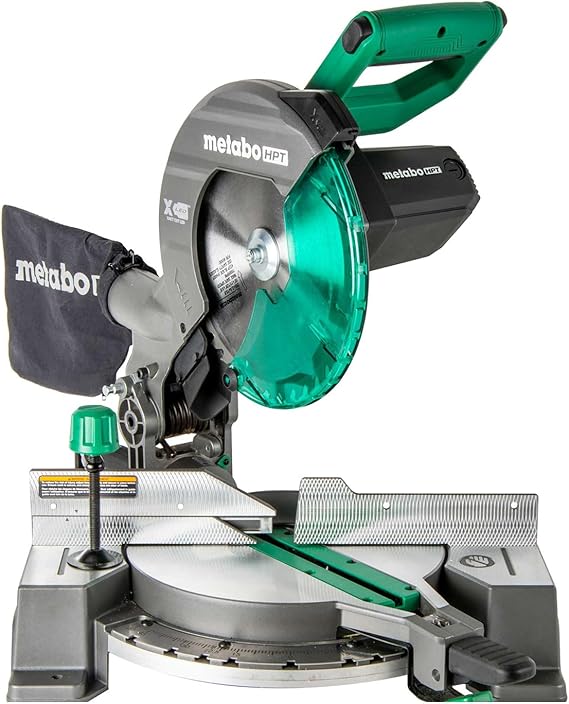
Powerful and lightweight, the Metabo HPT C10FCG2 compound miter saw is a solid choice for anyone needing precise cuts without extra bulk. Its standout feature is the 15-Amp motor that powers through wood smoothly, making it suitable for both hobbyists and professionals looking for a portable saw.
Setting up the saw is straightforward, with a user-friendly miter scale that helps dial in exact angles quickly. The large 10-inch table offers good support for your materials, while the vice clamping system keeps everything firmly in place during cutting.
Weighing just 24 pounds, it’s easy to move around the workspace or take to a job site.
Cutting performance is reliable thanks to the 5,000 RPM no-load speed and 40-tooth blade, which together provide clean, accurate cuts. The build feels durable yet light, making handling less tiring over time. Common praise mentions the saw’s power and precision, while some note the single bevel design limits cutting angles on more complex jobs.
The saw gets strong praise for delivering consistently precise cuts thanks to its powerful motor and solid clamping system. A common complaint centers on the single bevel design, which means users looking for dual bevel functionality will find this model limiting.
People who want a lightweight, portable miter saw for straight and bevel cuts will find this tool meets their needs well. Those requiring complex dual bevel angles or cordless convenience might want to consider other models in their search.
Pros
- Powerful 15-Amp motor for smooth cuts
- Lightweight design at only 24 lbs
- Large table with good material support
- Vice clamping system for safety and precision
Cons
- Single bevel limits angled cuts
- No cordless option available
| Specification | Details |
|---|---|
| Power Source | Corded Electric |
| Motor Power | 15 Amp |
| Blade Diameter | 10 inch |
| Cutting Angle | 52 degrees |
| Weight | 24 lbs |
8. Makita XSL05Z 18V LXT Brushless Compact Dual-Bevel Compound Miter Saw

Designed with a lightweight 14.6 lbs build and brushless motor technology, this Makita 18V LXT saw is perfect for those needing a portable yet powerful tool. Its compact size and battery platform make it suited for users prioritizing ease of transport and versatile cutting without the cord.
Setting up involves mounting a battery (not included) on the 18V LXT platform, which keeps the tool easy to handle on job sites. The automatic speed change technology adjusts cutting speed and torque on the fly, helping maintain smooth cuts without manual adjustments.
Its cordless design means you don’t have to stay near an outlet, and changing angles is quick thanks to its dual-bevel compound feature.
Cutting through baseboards or trim feels consistent thanks to the BL brushless motor, which runs cooler and lasts longer without carbon brushes wearing down. The motor’s efficiency supports up to 270 cuts per charge with a 6.0Ah battery.
Common feedback highlights how light and easy it is to move around. Some users note the battery needs to be purchased separately and that’s an added step before use.
Most users appreciate its lightweight design and efficient brushless motor for consistent, cool operation. The common drawback is needing to buy the battery separately, which adds extra cost and setup time before use.
Those who move frequently between job sites or need cordless operation will find this saw well suited to their needs. People needing a wider range of cutting angles or prefer a complete kit may want to explore other options.
Pros
- Lightweight with easy portability
- Brushless motor for longer life
- Automatic speed adjustment during cuts
- Runs up to 270 cuts per charge
Cons
- Battery not included
- Limited cutting angle at 90 degrees
| Specification | Details |
|---|---|
| Power Source | Battery Powered |
| Voltage | 18 volts |
| Weight (with battery) | 14.6 lbs |
| Number of Teeth | 80 |
| Batteries Required | 1 Lithium Ion |
| Cutting Angle | 90 degrees |
9. Makita LS1110F Slide Compound Miter Saw

A powerful 13.0 AMP motor and precise cutting angles make this miter saw ideal for woodworkers needing accurate and versatile cuts. Its biggest strength lies in offering excellent portability without sacrificing cutting power, making it a solid pick for both workshop and job site use.
Setting up requires little effort thanks to its compact size and manageable weight of 36.2 lbs. The soft start feature helps avoid jerky motions when you power it on. Adjusting the bevel and miter angles is straightforward with dual rear handle bevel locks and positive stops.
Built-in LED lighting is helpful for seeing the cut line in low-light areas, improving accuracy during daily tasks.
This tool cuts cleanly up to 12 inches at 90° and 8-1/2 inches at 45°, handling most standard material sizes easily. The linear ball bearing system provides very accurate cuts, which users frequently praise. While the build feels solid and well-engineered, some mention the limited right bevel range of only 2° as a drawback for certain angled cuts.
Precision and portability are the standout features, with many appreciating how the linear ball bearing system ensures dead-on cuts across job sites. The main frustration is how the bevel only tilts 2° to the right, restricting some cutting angles.
Those needing a dependable, accurate saw for light-to-medium woodworking tasks will find this saw fits well. People requiring wider bevel adjustments or cutting very thick lumber might look for heavier-duty or more versatile models.
Pros
- Compact and lightweight for easy transport
- Soft start ensures smooth operation
- LED light illuminates cut line clearly
- Accurate cuts with linear ball bearing system
Cons
- Right bevel range limited to 2°
- Not ideal for very large or thick materials
| Specification | Details |
|---|---|
| Power Source | Corded Electric |
| Voltage | 120 volts |
| Motor Power | 13.0 AMP |
| Blade Speed | 4,500 RPM |
| Cutting Capacity | 12” at 90°, 8-1/2” at 45° |
| Bevel Adjustment | 0°-47° left, 0°-2° right |
10. Makita LS1219LX Dual-Bevel Sliding Compound Miter Saw

Makita LS1219LX is designed for those needing a powerful and precise miter saw that handles large crown molding and wide crosscuts. Its unique single slide-glide system makes it a smart choice for pros who want smooth, accurate cuts and easy transport around the job site without sacrificing stability.
Setting up the saw is straightforward thanks to the compact folding stand with wheels and a handle, making it easier to move. Day-to-day use benefits from the in-front bevel lock which simplifies angle adjustments. Dual dust collection ports keep the workspace cleaner, and the 2-steel rail sliding system ensures smooth operation while cutting through bigger pieces like crown molding and baseboard.
Cutting performance is solid, handling up to 15 crosscuts and tall molding without strain. The build feels durable yet lightweight at 33.7 lbs due to the aluminum tubular stand.
Positive feedback often points to its smooth sliding and accurate bevel locking, while some mention the weight being noticeable during extended use or transport despite the folding stand.
Most praise centers on the smooth sliding rail system and accurate bevel locking that helps achieve professional cuts, while a common complaint involves the saw’s weight, which can become tiring to handle over long periods. Dust collection is effective, improving job site cleanliness.
Those working with large molding and needing portability will appreciate its balance of power and design. For users needing a lighter saw or without charging access, a non-battery model might serve better. This saw fits well for pros balancing job site mobility with capacity.
Pros
- Single slide-glide operation for smooth cuts
- Compact folding stand with wheels for portability
- Dual dust collection ports reduce workspace mess
- In-front bevel lock easier to adjust angles
Cons
- Weight can feel heavy during extended carrying
- Battery powered, so requires charge management
| Specification | Details |
|---|---|
| Power Source | Battery Powered |
| Voltage | 120 volts |
| Speed | 3200 rpm |
| Blade Teeth | 60 |
| Cutting Angle | 90 degrees |
| Weight | 33.7 lbs |
11. Makita LS1019LX Dual-Bevel Sliding Compound Miter Saw

Cutting large crown molding and wide baseboards accurately is tricky without the right saw, and this is where a solid sliding compound miter saw shines. Suitable for carpenters and serious DIYers, it stands out by matching the cutting capacity of a 12 saw in a more compact 10 model.
Setting up involves unfolding the compact stand with wheels, which makes moving it on site much easier. The single slide-glide operation through a specialized two-steel rail system makes swinging the saw smooth and controlled.
The in-front bevel lock is quick to adjust, and the see-through blade guard allows clear sight lines on every cut, helping keep things precise without fuss.
It handles crosscuts up to 12 and nested crown molding cuts up to 6-5/8 with confidence. The build feels sturdy yet lighter than many, weighing just 33.7 lbs thanks to the aluminum tubular stand. Users appreciate the accuracy and cutting power but note that portability still requires some effort given the size and weight.
Positive feedback highlights the saw’s cutting accuracy and smooth sliding action, making large and complex cuts manageable. However, its weight and stand design lead to critiques about portability challenges on busy job sites.
Professionals working on larger crown moldings and baseboards will appreciate its power and capacity. Those needing quicker, lighter options for smaller projects might look for a more compact or lightweight model instead.
Pros
- Single slide-glide operation for smooth cuts
- See-through blade guard improves cutting accuracy
- Compact folding stand with transport wheels
- Powerful 1800-watt motor handles large stock
Cons
- Heavier than typical portable miter saws
- Stand still requires effort to move despite wheels
| Specification | Details |
|---|---|
| Blade Size | 10″ |
| Cutting Capacity | 6-5/8″ Crown molding nested, 12″ crosscuts |
| Power | 1800 watts, 120 volts, 15 A |
| Weight | 33.7 lbs |
| Number of Teeth | 60 |
12. Makita XSL06Z 18Vx2 LXT Brushless Dual-Bevel Sliding Compound Miter Saw

Powered by two 18V LXT batteries, this miter saw offers cordless convenience with serious muscle. It suits woodworkers needing a battery-powered tool that maintains power and speed like a corded saw, especially across larger projects.
Setting it up is straightforward thanks to the bevel lock and the steel rail sliding system. The cordless design means no tangled cords limiting your workspace.
Two 5.0Ah batteries (not included) keep the saw running long enough for dozens of cuts before recharging. Automatic speed change technology adjusts torque during cuts, so you get cleaner results without constant adjustments.
Cutting feels smooth and fast thanks to a brushless motor spinning at 4,400 RPM. The motor runs cooler and more efficiently by eliminating brushes.
The steel rail system ensures slides are solid and steady. Most users praise its power and cut quality, while some mention the need for the dual batteries, which add weight and cost.
Power and smooth cutting stand out the most in everyday use. The convenience of cordless operation pairs well with long battery life, but needing two separate batteries adds cost and weight, which some find cumbersome during extended projects. The saw’s strong motor and stable sliding feel make cutting precise and consistent.
This saw works well for anyone focused on cordless freedom without sacrificing power or cut quality. Those prioritizing a lighter or more budget-friendly setup might prefer a corded model or a saw with single-battery use. It suits larger projects where extended run time and portability matter most.
Pros
- Delivers up to 334 cuts per charge with 2×4 lumber
- Brushless motor runs cooler and lasts longer
- Automatic speed change adjusts torque during cuts
- Steel rail sliding system for smooth and stable operation
Cons
- Requires two batteries, increasing weight and cost
- Batteries not included with the saw
| Specification | Details |
|---|---|
| Power Source | Battery Powered |
| Voltage | 36 volts |
| Speed | 4,400 rpm |
| Number of Teeth | 60 |
| Cutting Angle | 90 degrees |
Best Makita Miter Saws Comparison Table
| Product | Power Source | Voltage | Speed (rpm) | Teeth |
|---|---|---|---|---|
| Makita LS1219L Miter Saw | Corded Electric | 120 volts | 3200 | 60 |
| Makita LS1019L Miter Saw | Corded Electric | 120 volts | 3200 | 60 |
| Makita LS1040 Miter Saw | Hand Powered | – | 4600 | 80 |
| Makita XSL06PT Miter Saw | Battery Powered | 36 volts | 400 | 80 |
| Makita LS0816F Miter Saw | Corded Electric | 120 volts | 5000 | 24 |
| Makita XSL02Z Miter Saw | Battery Powered | 18 volts | 5700 | 60 |
| Metabo HPT C10FCG2 | Corded Electric | 120 volts | – | 40 |
| Makita XSL05Z Compact Miter | Battery Powered | 18 volts | – | 80 |
| Makita LS1110F Miter Saw | Corded Electric | 120 volts | – | – |
| Makita LS1219LX Miter Saw | Battery Powered | 120 volts | 3200 | 60 |
| Makita LS1019LX Miter Saw | Hand Powered | 120 volts | – | 60 |
| Makita XSL06Z Miter Saw | Battery Powered | 36 volts | 400 | 60 |
- Power SourceCorded Electric
- Voltage120 volts
- Speed (rpm)3200
- Teeth60
- Power SourceCorded Electric
- Voltage120 volts
- Speed (rpm)3200
- Teeth60
- Power SourceHand Powered
- Voltage–
- Speed (rpm)4600
- Teeth80
- Power SourceBattery Powered
- Voltage36 volts
- Speed (rpm)400
- Teeth80
- Power SourceCorded Electric
- Voltage120 volts
- Speed (rpm)5000
- Teeth24
- Power SourceBattery Powered
- Voltage18 volts
- Speed (rpm)5700
- Teeth60
- Power SourceCorded Electric
- Voltage120 volts
- Speed (rpm)–
- Teeth40
- Power SourceBattery Powered
- Voltage18 volts
- Speed (rpm)–
- Teeth80
- Power SourceCorded Electric
- Voltage120 volts
- Speed (rpm)–
- Teeth–
- Power SourceBattery Powered
- Voltage120 volts
- Speed (rpm)3200
- Teeth60
- Power SourceHand Powered
- Voltage120 volts
- Speed (rpm)–
- Teeth60
- Power SourceBattery Powered
- Voltage36 volts
- Speed (rpm)400
- Teeth60
How to Choose the Right Makita Miter Saw
Choosing the right miter saw depends on blade size, cutting capacity, and motor power to match your project needs. Prioritizing accuracy and safety features ensures better results and fewer mistakes, ultimately saving time and money on repairs or replacements.
Saw Type and Size
Working with a miter saw that doesn’t match the job can slow progress or make cuts impossible. Sliding miter saws allow the blade to move forward and backward, increasing cutting capacity on wider boards, while compound miter saws tilt the blade to make bevel cuts in addition to standard miter cuts. Dual bevel models simplify making bevel cuts on either side without flipping the workpiece.
Typical blade diameters range from 8 to 12 inches, affecting how deep the saw can cut, larger blades handle thicker material but add weight and size. A 10-inch blade is common for general woodworking, supporting cuts up to 2×6 lumber at 90 degrees and somewhat less at angles.
Size also determines how well the saw fits in limited workspaces or fits in a truck for jobs on location. Taller or bulkier sliding models need room to extend the arm, so a compact compound saw may be better if space or portability is tight.
Finding the right balance between blade size, saw type, and physical dimensions makes cutting various materials and angles manageable without repeated adjustments or awkward setups.
Motor Power and Performance
Cutting through dense hardwoods like oak or maple requires a motor with sufficient amperage and high RPM to maintain blade speed under load. A motor rated around 15 amps with speeds near 5000 RPM typically provides smooth, efficient cuts without bogging down. Lower power motors struggle with thicker or harder materials, leading to rough edges or slower progress.
On softer materials like pine or plywood, less motor strength might suffice, but that tradeoff reduces overall versatility.
A powerful motor also influences the precision and speed of the cut, you avoid forcing the saw through material or needing multiple passes, which can damage the workpiece and increase wear. Consistent RPM under pressure preserves blade life and keeps cuts straight, which is crucial for fine woodworking or trim where accuracy matters.
Cutting Accuracy and Adjustability
Precision depends heavily on how easily the saw’s angles adjust and hold in place during cutting. Saw models with positive stops at common angles such as 0°, 15°, 22.5°, 30°, and 45° miter cuts let users quickly dial in settings without guesswork.
Adjusting bevel angles should be smooth and secure, preventing shifts mid-cut that spoil accuracy. A solid fence keeps the material aligned, boosting cut consistency.
Clamping systems also make a difference. Without a reliable clamp, boards can move or vibrate, causing uneven cuts or kickback risks.
A quality clamp is simple to engage and holds stock firmly. Setting angles and securing materials easily reduces setup time and ensures professional results without repeated measuring or test cuts.
Safety Features
Effective safety starts with a blade guard that covers the blade completely when idle and retracts smoothly during cutting. Automatic braking systems stop the blade quickly after the trigger is released, minimizing injury risks.
These features become essential during fast or repetitive cuts on construction sites.
Dust collection connected to a shop vac or built-in port helps keep the workspace clear of sawdust, preventing visibility issues and respiratory irritation. Electric safety mechanisms like overload protection prevent motor damage if the saw is strained, and safety switches cut power in emergencies.
These combined features protect the user and prolong tool life.
Portability and Ease of Use
Portability often gets overlooked until the saw must move between job sites daily. Weight near 30 pounds can still be manageable, but anything heavier demands a wheeled stand or vehicle with good access. Compact design with built-in handles assists lifting.
Saw placement on a workbench also affects setup speed.
Controls should be straightforward: large, clearly labeled knobs or levers for angle adjustments make fine-tuning faster and reduce mistakes. Clear indicators for angles and blade position eliminate second-guessing during busy projects. Regular maintenance like blade changes or cleaning dust buildup varies by model, but simpler designs save time and reduce downtime in the long run.
Maximizing Precision: Expert Tips for Using Your Makita Miter Saw
To get the most accurate cuts from your Makita miter saw, start with proper calibration. Check the blade alignment against the fence and adjust the bevel angle as needed. Worn or dull blades can cause rough cuts, so sharpening or replacing the blade ensures smoother operation.
Keep these tips in mind for precision:
- Secure your workpiece firmly using clamps or the built-in hold-down to prevent movement.
- Use the laser guide or LED shadow if available to line up your cuts more accurately.
- Make several test cuts on scrap wood to confirm angles and settings before working on your project.
- Slow and steady blade movement produces cleaner edges without burning the wood.
Regularly clearing sawdust from the blade and fence also helps maintain cutting accuracy over time.
Essential Maintenance Practices to Prolong Your Makita Miter Saw’s Lifespan
Lubricating the moving parts of your Makita miter saw is essential to keep everything running smoothly. Light oil on the pivot points and slide rails reduces friction and wear.
Avoid using excessive lubricant to prevent dust buildup.
Other routine maintenance tasks include:
- Cleaning sawdust and debris after each use with a brush or compressed air to avoid clogging the motor and mechanisms.
- Inspecting the blade for damage and replacing it if you notice chips or dullness that affect cut quality.
- Checking the power cord and switch for any signs of wear or damage, which are important for user safety.
- Tightening bolts and screws regularly to prevent loosening due to vibration during operation.
Carrying out these steps frequently can extend the life of your saw and keep performance consistent.
Comparing Makita Miter Saws with Other Leading Brands: Pros and Cons
Makita miter saws are known for their build quality and reliable motors compared to other brands. They often come with user-friendly features like adjustable fences and smooth beveling systems.
However, Makita models tend to be pricier than some other makes, which might not fit all budgets.
Advantages of Makita include:
- Durable construction suitable for both professional and DIY work.
- Quieter operation compared to some competing saws.
- Good availability of replacement parts and accessories.
On the downside, some users find that the dust collection system could be improved, and the weight can make portability an issue. Other brands might offer lighter or more affordable options but sometimes at the cost of durability or cutting power.
Choosing between Makita and other brands depends on the specific needs and priorities of your projects.
People Also Asked
How Do I Properly Maintain a Miter Saw for Longevity?
Regularly clean sawdust and debris from the blade and motor vents. Lubricate moving parts lightly and check the blade for sharpness often. Storing the saw in a dry place helps prevent rust and keeps components working smoothly over time.
What Safety Gear Should I Use When Operating a Miter Saw?
Use safety glasses to protect your eyes from flying debris and ear protection to reduce noise exposure. Wearing a dust mask helps prevent inhalation of fine particles, especially when cutting materials like MDF or plywood. Keep gloves tight-fitting to avoid catching in the blade.
Can I Use Blades from Other Brands on This Miter Saw?
Blades from other brands can be used as long as they match the saw’s diameter, arbor size, and maximum RPM rating. Using the correct blade type for the material you are cutting improves performance and safety. Always double-check compatibility before installing a new blade.
What Size Miter Saw Is Suitable for Woodworking Projects?
A 10 or 12-inch miter saw works well for most woodworking tasks like trim, molding, and framing. Larger blades handle bigger stock and faster cuts but can be heavier and less precise for smaller workpieces. Choose a saw size that aligns with the typical dimensions of your projects.
Why Does My Miter Saw Blade Sometimes Leave Rough Cuts?
Dull blades or incorrect blade types often cause rough cuts. Make sure you use a blade designed for the specific material, such as fine-tooth blades for finish wood. Check that the saw’s fence is square and the blade is securely tightened to avoid vibration during cuts.
Conclusion
Choosing a miter saw depends on accuracy, blade size, and motor power. These factors affect how clean and precise your cuts will be and what material thickness you can handle. Also, consider the saw’s ease of adjustment and dust collection to keep your workspace manageable.
Think about your workshop space and how often you’ll use the saw before choosing. A smaller, lighter model works better in limited areas or for occasional tasks, while a heavier, more powerful saw suits regular use. Refer back to the comparison table and the detailed picks to find the option that fits your needs and budget best.

I’m Ryan Mitchell, an automotive writer with a solid background in vehicle diagnostics and repair. I cover brake problems, transmission issues, dashboard warning lights, battery troubles, and routine servicing. I explain technical problems in plain language so drivers understand what’s going wrong, talk confidently with their mechanic, and make smarter repair decisions.


